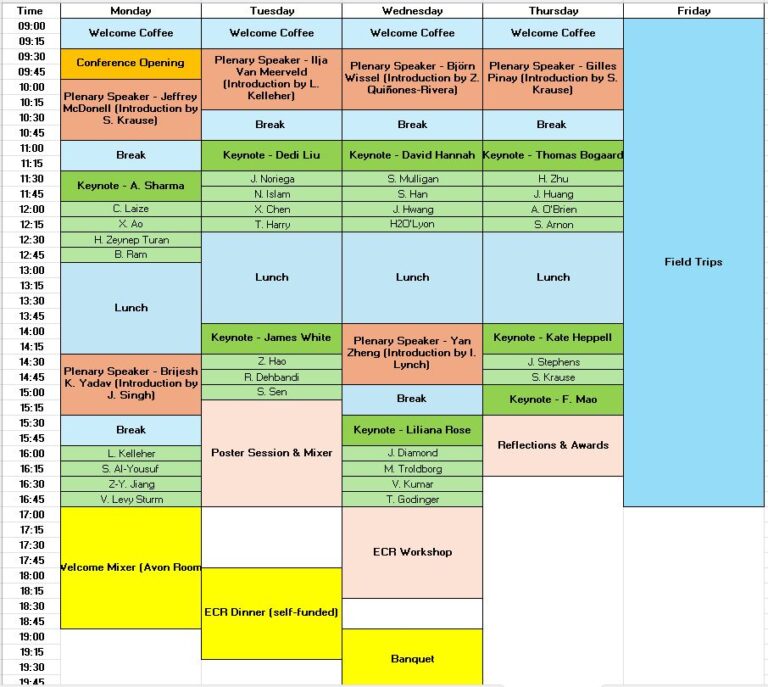





Monday 14th September 2026
Time | Session / Details |
09:00 | Registration / Welcome Coffee |
09:30 | Conference Opening |
10:00 | Plenary Talk – Jeffrey McDonnell, University of Saskatchewan Catchment storage: The grand challenge beneath our feet |
11:00 | Break |
11:30 | Keynote – Ashutosh Sharma, IIT Roorkee Ecohydrological Impacts of Climate Change and Climate Extremes on Vegetation Productivity and Drought Resilience in India |
12:00 | C. Laize, UK Centre for Ecology & Hydrology Future ecological risk due to climate and human-induced flow alteration in seven European river basins |
12:15 | X. Ao, SUSTech When water pollution governance distorts corporate green innovation: evidence from China |
12:30 | H. Zeynep Turan, Delft University of Technology Daily Dynamics in Fraction of the European River Water That Is Actually Wastewater Effluent |
12:45 | B. Ram, Kurukshetra University Hydrogeochemical controls on fluoride enrichment and associated human health risks in groundwater of Mahendragarh district, Haryana, India |
13:00 | Lunch |
14:30 | Plenary Talk – Brijesh K Yadav, IIT Roorkee Unravelling interaction pathways between terrestrial groundwater and coastal ecosystem along southeastern Arabian sea coast |
15:30 | Break |
16:00 | L. Kelleher, University of Birmingham SMARTSAMPLING: a low-cost, open-source portable online water autosampler for environmental monitoring |
16:15 | S. Al-Yousuf, University of Birmingham Defining Dry–Wet Abrupt Alternation (DWAA) Events: A Sensitivity-Based Detection Framework Across UK Catchments |
16:30 | Z. Jiang, University of Birmingham Observation and modelling the water and associated nitrogen processes regulated by forest canopy |
16:45 | V. Levy Sturm, Ben-Gurion University of the Negev The effects of stream bed motion and fiber length on microplastic deposition |
17:00 | Welcome Mixer (Avon Room) |
Tuesday 15th September 2026
Time | Session / Details |
09:00 | Welcome Coffee |
09:30 | Plenary Talk – Ilja Van Meerveld, University of Zurich A visual approach for citizen-based water quality monitoring |
10:30 | Break |
11:00 | Keynote – Dedi Liu, Wuhan University Estimating Water Resource Utilization Rate Thresholds under Synergistic Optimization of the Water Supply–Hydropower Generation–Environment Conservation Nexus |
11:30 | J. Noriega, Northwestern University Detection of Water Quality Hot Moments from High-Frequency Data in the Little Calumet River Watershed |
11:45 | N. Islam, University of Birmingham Seasonal and inter-annual variations in stable isotopes reveal hydrological functioning in an Alpine catchment |
12:00 | X. Chen, Sun Yat-sen University Multiscale effects and drivers of landscape heterogeneity for water-related ecosystem services in urban agglomerations |
12:15 | T. Harry, University of Birmingham AI-Assisted Screening of Coastal Groundwater Salinity Risk in South-East England |
12:30 | Lunch |
14:00 | Keynote – James White, University of Birmingham One Health for Freshwater: A unifying framework for holistic management visions |
14:30 | Z. Hao, Beijing Normal University Impacts of temporally compounding hot-dry events on agricultural droughts via vegetation |
14:45 | R. Dehbandi, University of Science and Technology of Mazandaran Towards a National Perspective on Geogenic Fluoride in Iranian Groundwater: Hydrogeochemical Controls, Human Health Implications, and Future Challenges |
15:00 | S. Sen, IIT Roorkee Geomorphic controls on transient storage and hyporheic exchange in a mountainous headwater stream |
15:15 | Poster Session & Mixer |
18:00 | ECR Dinner (self – funded) |
Wednesday 16th September 2026
Time | Session / Details |
09:00 | Welcome Coffee |
09:30 | Plenary Talk – Björn Wissel – University of Lyon 1 EcoHydrology in the context of One Health, One Water, One Planet |
10:30 | Break |
11:00 | Keynote – David Hannah, University of Birmingham Getting into hot water: drought and heatwave impacts on river temperature |
11:30 | S. Mulligan, Universidade Federal do Cariri, Universidade do Algarve Cariri and Ecohydrology: An analysis of water quality in the Salgado River Basin and the potential of nature-based solutions in semi-arid Brazil |
11:45 | S. Han, University of Birmingham Changing Hydroclimatic Extremes: Event-Based Analysis of Droughts, Floods, and Their Transitions |
12:00 | J. Hwang, University of Birmingham Regimes of interannual variability in harmful cyanobacterial blooms in an Asian monsoon reservoir |
12:15 | H20’ Lyon |
12:30 | Lunch |
14:00 | Plenary Talk –Yan Zheng, SUSTech From MAR to MARS
|
15:00 | Break |
15:30 | Keynote – Liliana Rose, WSP We Know They Work. Now What? The Five Questions That Will Shape the Future of Nature-Based Solutions – A view from Consultancy |
16:00 | J. Diamond, UNESCO Antimicrobial Resistance in the Water Cycle: A One Health Perspective on Emerging Ecohydrological Risks |
16:15 | M. Troldborg, The James Hutton Institute A Bayesian network approach for probabilistic assessment of pharmaceutical risk from wastewater discharges in a Scottish river catchment |
16:30 | V. Kumar, Kurukshetra University Hydrogeochemical Assessment of Groundwater Quality and Arsenic Mobilization in the Central Ganga Plain, India |
16:45 | T. Godinger, Ben-Gurion University of the Negev Water quality dynamics and stream metabolism in a mediterranean lowland urban stream |
17:00 | ECR Workshop |
19:00 | Conference Dinner at Lapworth Museum |
Thursday 17th September 2026
Time | Session / Details |
09:00 | Welcome Coffee |
09:30 | Plenary Talk – Gilles Pinay, CNRS & University of Lyon 1 HydroEcology challenges under global change |
10:30 | Break |
11:00 | Keynote – T. Bogaard, Delft University of Technology Nature-based solutions in an era of changing climate extremes and planetary health: what can (eco)hydrology contribute?
|
11:30 | H. Zhu, Nanjing University of Information Science & Technology Seeing the Unseen Dynamics: Opportunities and Challenges of In situ High Frequency Sensor Networks |
11:45 | J. Huang, Nankai University Earlier, longer, and less visible: a 25-year satellite record of algal bloom exposure and its thermal tipping points in a shallow eutrophic lake
|
12:00 | A. O’ Brien, UKCEH Aqua-rep: a controllable river microcosm facility for testing aquatic responses at the water-health interface |
12:15 | S. Arnon, Ben-Gurion University of the Negev Experimental and modeling results reveal the effects of ripple celerity on the fate of trace organic compounds in streams |
12:30 | Lunch |
14:00 | Keynote – Kate Heppell, Chilterns National Landscape Linking research, practice and community through citizen science for improved river and human health |
14:30 | J. Stephens, Flinders University Beyond hospital data: community health impacts of a harmful algal bloom revealed through participatory surveillance |
14:45 | S. Krause, University of Birmingham |
15:00 | Keynote – Feng Mao, University of Warwick and University of Lagos Localising Global Water Security Data through Participatory Interpretation in Nigeria
|
15:30 | Reflections and Awards |
Friday 18th September 2026
Time | Session / Details |
Morning Session | BiFOR field trip |
Afternoon Session | BiFOR field trip |
Poster Number / Author | Title |
1. Jing Liu | Identification of the key factors affecting the distribution of nutrients in a dam-controlled river |
2. Bethany Gill | To Paddle or not to Paddle? Examining Microbial Contamination and Risk to Recreational Water Users across Nottinghamshire’s Waterways |
3. Chandni Thakur | Impact-Based Flood Preparedness to support Healthcare Systems in Bihar, India |
4. Ellie Hannah | Controls and Processes Driving Urban River Water Quality Dynamics: Insights from High-Frequency Monitoring of the Bourn Brook, Birmingham |
5. Greta Gustafsson | Impacts from Hydroclimatic Extremes on Freshwater Ecosystems in Forest Landscapes |
6. Guilin Luo | Spatial and vertical heterogeneity in event-scale forest soil moisture responses to rainfall |
7. Jaswant Singh | Assessing the Performance of Open-Source and Low-Cost Sensors for River Water Quality Monitoring |
8. Kai Liu | Understanding the vertical mobility of microplastics in the open ocean: from particle transport to plastic carbon cycling |
9. Shane Querubin
| Assessing microplastic abundance and distribution in an urban stream network |
10. Samuel Garnham | Finding Ways to Reduce Mining Impacts on Biodiversity for the Battery Revolution Using a Fuzzy Logic GIS Approach to Quantify Risk |
11. Sergio Mendes | Heavy Metal Ecotoxicity from Battery End‑of‑Life Failures: North–South Species Disparities, Data Gaps, and Multi‑Omic Approaches for Toxicity Ranking and Biomonitoring |
12. Uwe Schneidewind | Advancing the analysis of temperature time series to determine vertical streambed fluxes |
13. Zhiyong Liu | How Vegetation Greening and Management Practices Influence Surface Evapotranspiration and Ecosystem Resilience |
14. Kieran Gething | It’s getting hot in here: variation in surface and subsurface temperatures along a water permanence gradient |
Guidelines for HydroEco26 Poster Presentations:
Posters will be in display for the entire duration of the congress. You will receive your poster-board location either before or during registration.
Dedicated poster sessions will take place on Tuesday 15th September.
It is strictly prohibited to take photos of any scientific material without the explicit permission from the authors. Authors are therefore asked to indicate explicitly on their poster whether photography is encouraged or not permitted.
- The required poster size is A0 (841 mm x 1189 mm or 33.1 inches x 46.8 inches) in portrait format.
- Place the title of your abstract clearly at the top of the poster to allow viewers to easily identify your work. Indicate the authors’ names and address information in order to allow interested viewers to contact you for more information.
- Use a size sufficient to be read at a distance of 1.5-2.0 m. We recommended using a minimum font size of 16pt.
- There will be pins available to hang your poster at the poster-board. In case of missing pins, please consult our conference assistants in the poster area.
- Conference assistants in the poster area may assist authors in putting up or taking down posters.
Posters need to be removed by Thursday noon. After this, conference assistants will remove and discard any remaining posters.
Abstract Submissions
Abstract Guidelines: Submit your abstract using the following format and indicate the session topic your work is aligned with.
- The title of the abstract must be in all caps and must not exceed 160 characters.
- The body of the abstract must adhere to a maximum character count of 1600, including spaces. This is exclusive of the abstract title and the author list. Please make the abstract as informative and representative of your presentation as possible.
- The abstract body should be clear and concise, with abbreviations and acronyms spelled out.
- It should not include citations.
- Please state your preference of presentation (oral/poster).
 Location
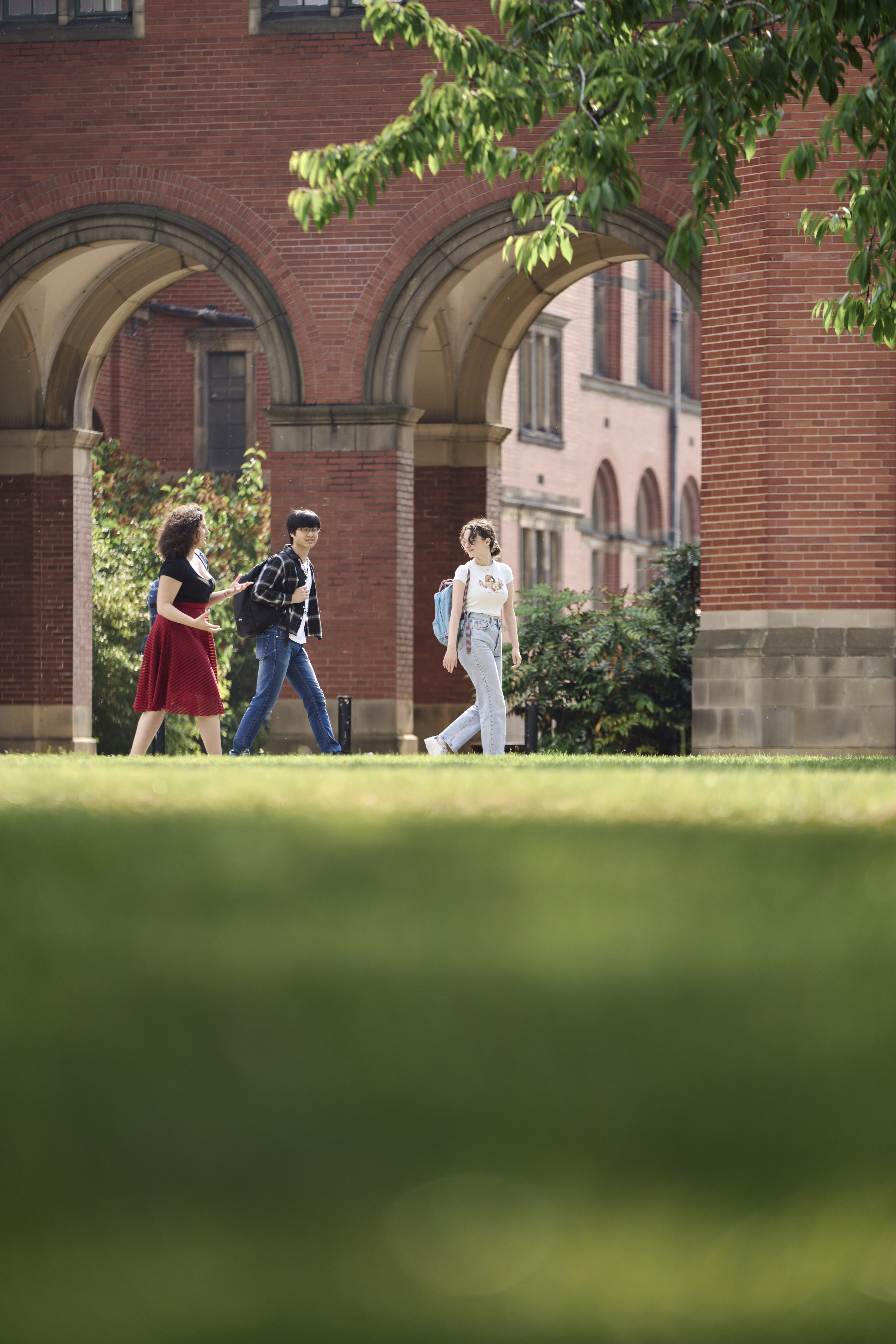
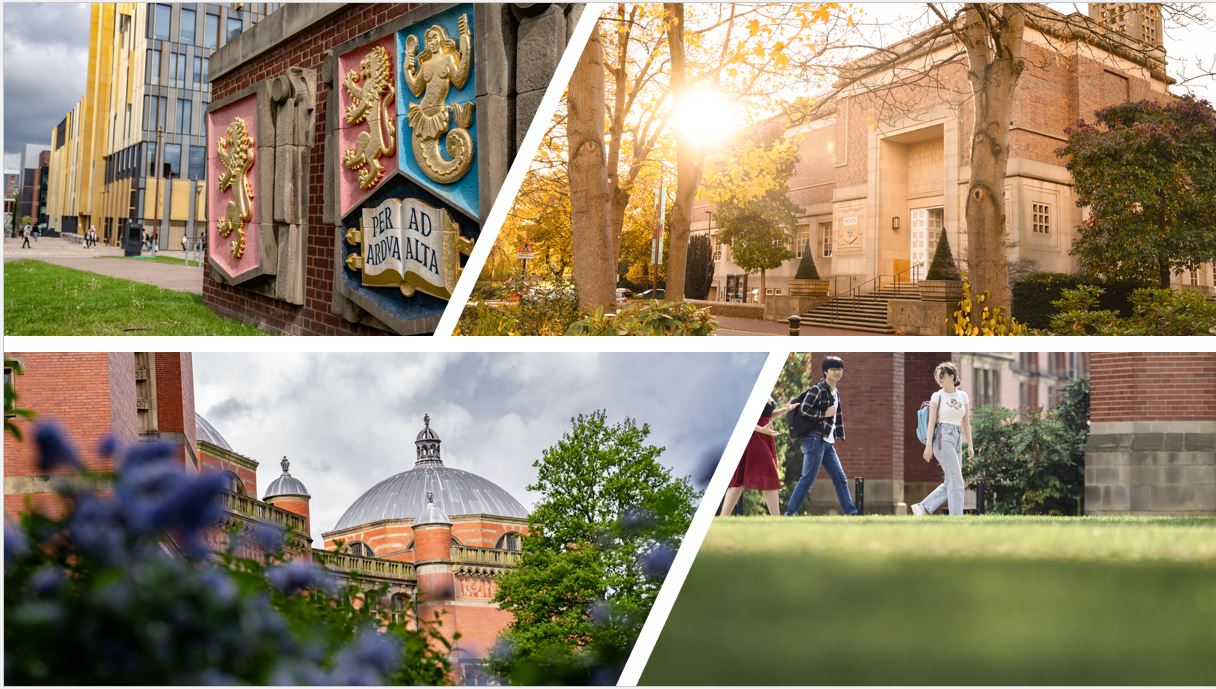
The conference will take place at the University of Birmingham. The room allocated for the conference is the University Centre, Avon Room Lecture Theatre. Lunch and poster display will take place in the dedicated catering space outside of the room.
The University Centre is centrally located on campus with many places to get food, drinks, and nearby shopping. It is a 5 minute walk from the University train station.
Travel Information
About Birmingham
Situated in the heart of the United Kingdom, Birmingham is a dynamic and diverse city celebrated for its rich history, cultural vibrancy, and spirit of innovation. Once at the centre of the Industrial Revolution, the city has evolved into a modern hub for business, education, and creativity, while maintaining the warmth and character that define its heritage.
Birmingham offers something for everyone, from world-class museums, theatres, and galleries to beautiful parks and a thriving food scene that includes several Michelin-starred restaurants. Its extensive canal network, lively shopping districts, and renowned music and cultural festivals make it a city full of energy and discovery.
Well-connected by road, rail, and air, Birmingham serves as an ideal meeting point within the UK. With state-of-the-art venues, excellent accommodation, and a welcoming atmosphere, it provides the perfect backdrop for conferences, events, and exploration alike.
Getting to and from the airport
Visa
How to apply for a visa to come to the UK: Choose a visa – GOV.UK
Accommodation
There is a range of hotels in short proximity to the University of Birmingham:
Edgbaston Park Hotel – on campus
Peter Scott House Birmingham – few minutes away from campus
Ibis Budget Birmingham Centre – approx 5 minutes away in a taxi
Please use online booking tools to find other suitable accommodation. We have a campus train station, with trains running regularly from Birmingham New Street to University, so you could also find suitable accommodation in Birmingham City Centre.

Committee Members & Organizers
Scientific Advisory Committee
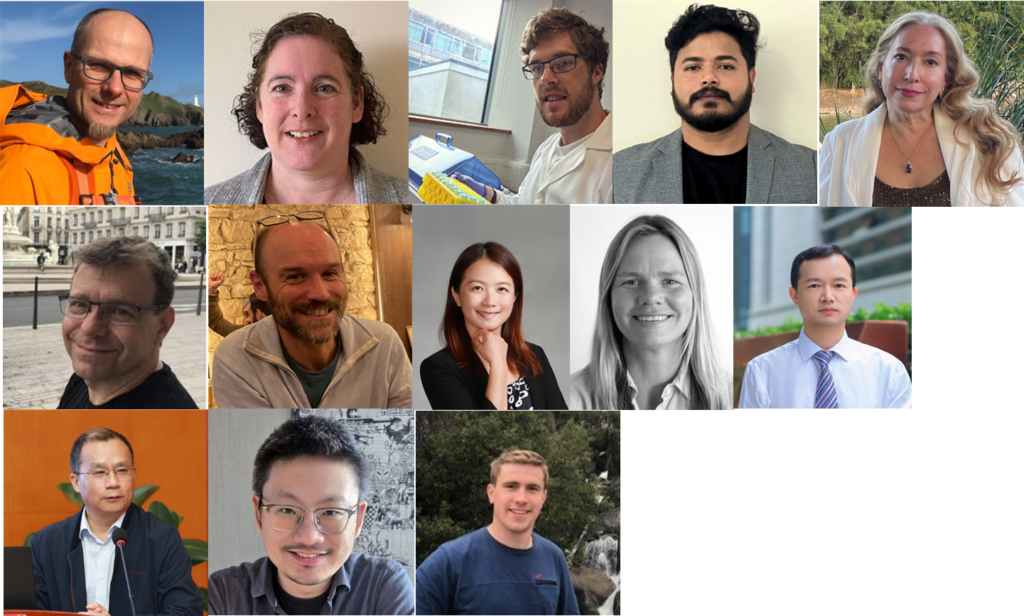
Stefan Krause (Conference Chair) – University of Birmingham, UK
Iseult Lynch (Conference Chair) – University of Birmingham, UK
David Hannah (Conference Chair) – University of Birmingham, UK
Liam Kelleher (Conference Chair) – University of Birmingham, UK
Jaswant Singh (Conference Chair) – University of Birmingham, UK
James White (Conference Chair) – University of Birmingham, UK
Zoraida J. Quiñones-Rivera (Conference Chair) – Université Claude Bernard Lyon 1, France
Laurent Simon (Conference Chair) – Université Claude Bernard Lyon 1, France
Yan Zheng – SUSTech, China
Ilja van Meerveld – University of Zurich
Björn Wissel – Université Claude Bernard Lyon 1, France
Feng Mao – University of Warwick
Brijesh Yadav – IIT Roorkee
Ashutosh Sharma – IIT Roorkee
Dedi Liu – Wuhan University
Hongzheng Zhu – NUIST Nanjing University of Information Science and Technology
Xiaohong Chen – Sun Yat-sen University
Award Winners – Sponsored by UNESCO
Congratulations to our two winners for their fantastic contributions:
Early Career Researcher Award – Oral Presentation
Awarded to
VERENA LEVY STURM, Ben Gurion University of the Negev, Israel
The Effects of Stream Bed Motion and Fiber Length On Microplastic Deposition
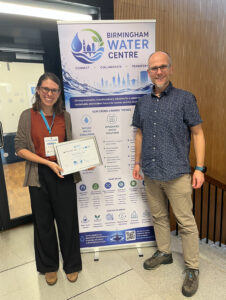
Best Poster Presentation Award
Awarded to
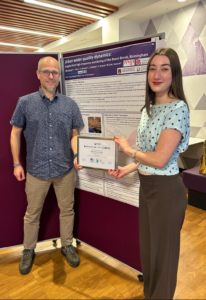
ELLIE HANNAH – WSP, UK
Controls and Processes Driving Urban River Water Quality Dynamics: Insights from High-Frequency Monitoring of the Bourn Brook, Birmingham